Showing posts with label recommended books. Show all posts

Tuesday, January 06, 2009

Blockbuster or Bust

The other day I came across an interesting article on the Wall Street Journal Online called Blockbuster or Bust Why struggling publishers will keep placing outrageous bids on new books

It talks about how even in our difficult economic times publishers still make it a practice to put big, big bucks on books they hope will turn out to be blockbusters, and how the entire system actually runs in such a way as to discourage anything else. They also rely on the big sellers to support the other books on their lists. One company cites the fact that 80% of its sales and an even larger share of its profits came from just 20% of its titles in 2006.

As an example the article cited publisher Grand Central, which in 2007 allegedly paid $1.25 million to buy the rights to Vicki Myron's "Dewey: The Small-Town Library Cat Who Touched The World," a nonfiction book about an abandoned kitten found in the returned-book slot of an Iowa public library. Why did they choose this book for all that money? The selling point is that it's like the recent blockbuster, Marley and Me (a recently released movie, which I have yet to see but intend to; not sure Marley has anything on Quigley, actually).

I've always been somewhat annoyed when marketers, agents, editors, and assorted publishing advice givers want me to tell what other books on the market are like mine, because for a long time I didn't know of any. I would say well The Enclave is like Sigmund Brouwer's Double Helix because it's got genetics in it. But Enclave isn't anything like Double Helix. Or, the Legends of the Guardian King series is like Lord of the Rings. But different. (Which is like saying chocolate chip cookies are like brownies, but different, in my opinion). The LOTR tie was the route marketers took, for better or for worse with Legends of the Guardian King. There really wasn't anything else out there. And after reading the article, I understand a little more why they do it.

Here's an excerpt:
"Media companies' hit-focused marketing did not emerge in a vacuum. It reflects how consumers make choices. The truth is that consumers prefer blockbusters. Because they are inherently social, people find value in reading the same books and watching the same movies that others do. This is true even in today's markets where, thanks to the Internet, buyers have easy access to millions and millions of titles. Compounding this tendency is the fact that media products are what economists call "experience goods": that is, shoppers have trouble evaluating them before having consumed or experienced them. Unable to judge a book by its cover, readers look for cues as to its suitability for them, and find it very useful to hear that "Dewey" is "a 'Marley & Me' for cat lovers." In much the same way that potential publishers do, readers value resemblances to past favorites.


I think I must be different than most readers, and maybe my trouble finding books that are like mine to offer marketers as sales tools originates in my relationship with reading. First of all, I'm more likely NOT to read a book that's a blockbuster because so many of them have been disappointments.

Second, when I look at the stories and books I've loved, I don't see a lot of resemblance to each other among them: Watership Down, Lord of the Rings, Horatio Hornblower, The Farseer Trilogy, Watchers, Miles Vorkosigan, Captain Blood, Jurassic Park, Without Remorse, The Scarlet Pimpernel... In fact, I tend not to like books that are like my favorites and try them with trepidation and the expectation that they will not measure up. I adore Forester's Hornblower series, own almost every one of them (I have 9 of the 11 books in the series, plan to eventually buy the other two), and have read many of them multiple times. I couldn't make it through the first chapter of Patrick O'Brien's sea stories, even though they're supposed to be similar. They're not, not to my way of thinking. I didn't even like the movie, and that was with Russell Crowe in it. (Which was admittedly the best part of it... Okay, I like the sea and the ship stuff, but the whole rest of the story was not my cup of tea.)

I loved Watership Down. But Redwall is in the pile with the O'Brien Books. Lord of the Rings has a ton of ripoffs and I'll admit I did like The Sword of Shannara when I read it as a young adult because it was simpler and shorter and easier to read. That opinion has not survived the years, however, and has, in fact, reversed. LOTR has a lot more depth and substance and now Shannara just seems...like a rip off. There are multitudes of Clancy and Koontz clones, too, but I haven't been able to generate interest in any of them.

Well, I always knew I was not in the mainstream. Because there is one main similarity between 60% of the titles I listed above just off the top of my head and that's the science fiction/fantasy/action element. Which right there puts you out of the mainstream.

You can read the full article HERE.

~~~

Monday, February 04, 2008

Q and A: Favorite Books, Part 2

QUESTION: How do you decide which book to take into your hands, and which book to stop reading if it goes too far, and how do you detach yourself from the content of it?

ANSWER: One of the important things I've learned about is the existance of "Divine Institutions", a social order of authority that God has set up for mankind. There are four of them and they are, 1) the sanctity of each person's individual volition in choosing things in life, 2) marriage (with the man in authority over the woman), 3) family (parents in authority over the children) and 4) nationalism (which includes military activity, which the Bible sanctions. Another huge subject). These institutions are not just for Christians but for everyone, and many unbelievers abide by them. Particularly in times past.

Many so-called "secular" books uphold these principles as they tell their stories. The Hornblower series comes to mind in this regard. Honor, courage, self-sacrifice and true principles of leadership and chain of command abound. As well as many other elements, including some analogies to Christ that I doubt the writer intended, but that I've found very illuminating.

Generally secular books portray people as they are without a relationship with Christ. Personally I'm not interested in reading about too much of this without the establishment principles -- I don't care for books that follow a person as he sins and sins and sins and that's the end. I want books that end well, where the characters learn something valuable and true, because the truth is, we who have a relationship with God through Christ do have a good ending ahead of us. Another truth is that people who live by the divine institutions as unbelievers will be blessed. I like books where justice and good prevail, because in the end they do. I can usually tell from the synopsis of the book or a review where it's going, and make my decision about reading a book accordingly.

As for how do I detach myself from the content, usually I don't do it very well. Which is one reason why I try to stop reading before I get far enough into it that I'm going to have a problem. And also another support for daily study of God's word. It helps to break the influence some books' worldly and evil contents might have gained over my thinking.

Grace,
Karen

Sunday, February 03, 2008

Q and A: About Your Favorite Books List

QUESTION: "As a relatively new believer, I now read ... exclusively books written by Christian authors. I have seen the list of books you recommend, and many of those books are not written by people who believe. How do you select these books for you? How do you keep from being affected by views of people who may not know the truth? I know it is essential for you, being an author, to develop your skills through reading other authors, but how do you decide which book to take into your hands, and which book to stop reading if it goes too far, and how do you detach yourself from the content of it?"

ANSWER: The single most important way I protect myself is through the daily intake of the Word of God by means of the man I believe is my right pastor teacher. My pastor studies the Bible daily and deeply, then teaches (almost daily) based on his understanding of the original languages, the historical and cultural setting at the time of writing and how other pertinent scriptures in the Bible compare to the one being looked at.

After becoming saved, the new believer is challenged "to grow in grace and the knowledge of Jesus Christ." "God is spirit and we must worship Him in Spirit (the Filling of the Holy Spirit) and in truth (knowledge, belief and application of the word of God)." We are to "present our bodies a living sacrifice" (bring them to where they can hear the word being taught) so that our minds might be renewed or, more accurately, renovated. God's ways and thoughts are not our ways. There is a complete worldly/human way of thinking that is totally different from God's viewpoint. We must set ourselves to learn His viewpoint and make it ours.

In any subject we care to master (tennis, bridge, computer games, a foreign language, math) the more we study and practice it, the faster and better we learn it. Daily practice is the best. So why not apply that obvious principle to the most important thing of all: our spiritual lives and relationship with God? Through the daily study of God's word I come to learn what is truth and what is false.

It's not just knowledge of the word of God, however, that helps me choose my reading material. I also rely on the filling of the Holy Spirit to guide me. If I start a book and don't like the things I'm reading... I quit.

I suggest you do likewise. If you don't feel led to read a book at all, don't. If you read something by an author that you see is very much against the Word but is being presented as fine and even good or normal, stop and don't read any more by that author. I have a couple of authors whose past work I've loved but who are moving in directions I don't care for. Life is short. You don't have to finish every book you start and you certainly don't have to read all the books you think you might like to or that people tell you you should. (Also, if I'm not completely caught by a book in the first chapter or so, I often skim through to find out where it's going, how it ends. If I don't like it, I set it aside, which is just what I did -- standing in the store -- with Philip Pullman's Dark Materials trilogy .)

You're right to be concerned about all this. We are to take care what we hear and see and read...

Tomorrow, Part 2: A few things that help me to select and enjoy secular books.

Grace,
Karen

Monday, July 16, 2007

Wordless Recreation

Well, after being so tired last night, I didn't expect to have a lot of energy or get much done on the book today, and I was right. I woke up still tired and when it came to thinking about Black Box, my brain had reverted to its turnip state. I've been wondering for awhile why Mondays keep being down days, and I think at least one reason may be that usually on the weekends I have a lot of social contact and do a lot of talking.

I think I’ve posted before about the writer’s supposed need for solitude and long periods of idleness or leisure, mentioned by Dorothea Brande in her classic book Becoming a Writer. I’ve never been totally sure I believed that, though more and more it does seem to be true. At least for me. She also mentions a need to spend recreational time not engaged in activities that involve words.

When I think about it, I realize that much of what I does involve words, particularly the generating of them -- either in writing my work in progress (WIP), or doing the blog or the newsletter or in answering emails. I tend to think of the blog and emails as "recreation," things I do when I'm done writing for the day, but more and more I find it difficult to that. They all pull words out of me. So does conversation. I’d read from other writers about the dangers of talking about your work in progress to others – how it tends to suck away the impetus to write it down. I just end up feeling like I am empty. That all the words have been spilled out, like water from a desert well and must somehow be replaced before I can continue.

Ms Brande addresses this in her book:

"If you want to stimulate yourself into writing, amuse yourself in wordless ways. Instead of going to a theater, hear a symphony orchestra or go by yourself to a museum; go alone for long walks or ride by yourself on a bus. If you will conscientiously refuse to talk or read, you will find yourself compensating for it to your great advantage."

I'm not sure what I think about the reading part. In the past reading has not been a problem and often stimulates me back into writing. But it's definitely true about the talking and if I do too much writing of any kind I seem to require times of not writing.

Today almost all I did was wordless -- housework, making a birthday card, shopping... I didn't try to force anything, just did what I felt like doing. It seemed to work. Even though it's late, I feel less tired now than I did when I woke up.

I'm hoping tomorrow to see more progress on the WIP.

Grace,
Karen

Wednesday, July 11, 2007

From the Corner of His Eye

Yesterday I wrote about why I dealt with Gillard the way that I did in Return of the Guardian King, how I ...

*** more spoilers ***

***

***

***

... more or less phased him out of the narrative, both in terms of words addressed to him and in terms of his importance to the plot. When I was done, and encountered the objections of some readers who wanted to see more of him, I was reminded of a similar phenomenon in one of Dean Koontz's books.

A few years ago I read Koontz's From the Corner of His Eye, one of the two autographed hardbound books he sent me in response to a letter I'd written to him (the only letter I've ever written to an author!). I enjoyed it, of course, because I enjoy all of his books. I like his characters, I love his use of language, and I'm intrigued by some of the things that he does as a writer -- the names he gives his characters, the different allegorical elements in his stories, the plots, etc. In this book one of the themes was that evil is really empty and ultimately ineffectual. I'm not sure he intended this, but it's a beautiful truth relative to Satan and the Kingdom of Darkness. Satan's a lion and a hunter, but in the end, he has no teeth. Jesus has already defeated him. We just have to believe that and act accordingly.

Which, since we are fallen people living in the midst of a world of deception, isn't always so easy.

Anyway, in From the Corner of His Eye, Koontz introduces a perfectly awful villain in Enoch "Junior" Cain (and the name, of course, is no accident). [As an example of interesting things Koontz does with names, the hero, Bartholomew, starts out as a baby born to Agnes and Joseph, whose uncles are Jacob and Edom (where Esau lived) Isaacson... The co-hero, an ex-priest turned cop is Thomas Vanadium, vanadium being one of the elements on the periodic table, often used as a catalyst or in alloys. The "Thomas" harkens back to Doubting Thomas, as does the character.]

Anyway, back to Junior Cain. In the first few pages Koontz takes you from the beauty and wonder of a hike in the lush Oregon woods ("The primeval forests of the Oregon coast raised a great green cathedral across the hills, and the land was as hushed as any place of worship...") to the complete arrogance and self-delusion of this psychopath. He kills his wife, whom he tells himself he loves deeply and thoroughly, by shoving her off a lookout tower, for reasons I can no longer recall -- money, I believe. He derives a great feeling of power and life from doing it. And also remorse...

The self-delusion is fascinating and the journey is one where gradually you -- and Junior -- realize that he's hollow. He has nothing inside himself, no real capacity to enjoy anything, even though he has everything -- money, good looks, charming personality, the ability to commit a heinous crime and get away with it (which gives him great pleasure for a time). Eventually, as he sinks deeper into delusion and depravity, imagining himself to be greater than any other man, his disgusting insides begin to manifest on the outside. At the end, he is no longer handsome, but bald, pocked and burned, his life unraveling around him as his deeds come back to bite him.

And in the end, when you are expecting a big confrontation between him and Thomas...


**Spoilers here, too ***


*** Also some bad words***


*** Beware!***


...when you are expecting a big confrontation between him and Thomas, you don't get it. Cain is dispatched in a suprising and almost casual way that is completely anticlimactic. At first I was mildly put off, even a bit puzzled and disappointed. But then I thought about it and realized it was exactly right. Remember the point that Koontz kept making through the narrative? One of the walk-on characters encapsulates it well midway through the book:

"The problem with movies and books is they make evil look glamorous, exciting, when it's no such thing. It's boring and it's depressing and it's stupid. Criminals are after cheap thrills and easy money, and when they get them, all they want is more of the same, over and over. They're shallow, empty, boring people who couldn't give you five minutes of interesting conversation if you had the piss-poor luck to be at a party full of them. Maybe some can be monkey-clever some of the time, but they aren't hardly ever smart. God must surely want us to laugh at these fools, because if we don't laugh at 'em, then one way or another, we give 'em respect. If you don't mock a bastard like Cain, if you fear him too much or even if you just look at him in an all-solemn sort of way, then you're paying him more respect than I ever intend to."

I kinda think that's a good way to regard Satan, too.

Anyway, I saw it as perfectly right to have Cain eliminated by the weakest characters (physically, anyway) in the book, in an almost comical way to boot. If you go to the Amazon reviews, though, many readers were extremely distressed by the ending. Those who were didn't seem to understand at all what Koontz was doing. They were looking for something that wasn't there. They wanted Watchers or Intensity, and it wasn't that.

All of which I find interesting. Our frame of reference as well as our willingness to see what is actually being presented (rather than what we want to be presented) affects how we perceive things. If you don't see all the things he's putting in, don't make the connections between what's happening to Junior and statements like the above, then when you get to the end, you won't get what you're expecting and disappointment is in store.

Hmmm. I think this concept relates to our relationship with God, too. If we don't really know what His plan is about, then when we get to the end, we're going to expect something that isn't part of it, something entirely different than what He has in store.

Tomorrow, the last two questions...

Grace,
Karen

Monday, June 04, 2007

Marathon Reading Binge

Well. I'm not sure what exactly happened to me this weekend, but I suspect Saturday night had something to do with it. I went to Barnes and Noble Saturday morning and bought Fool's Fate, the last in Robin Hobb's Tawny Man Trilogy. I planned to make myself wait a bit to read it. But that night my hubby was off at a track meet and about 6pm I was finishing dinner and it was sitting there on the table and I picked it up, just to see how it started.

Which was a silly excuse even for myself, since I'd already read how it started at the end of Golden Fool. Nevertheless, I picked it up. It's a 900+ page book. I soon realized that the things I wanted to know would not be swift in coming and almost from the start I began my skim reading mode -- leaping over descriptions, exposition, and all the little historical excerpts that begin each chapter. I didn't get up from the chair at the dining room table once I started it. Not to turn off the cooler when it got too cold, not to go to the bathroom, not to go eat when I got hungry again sometime around midnight. That's also when my hubby came home from the track meet. He had brought dinner, and I ate one of his french fries, conversing distractedly with him about the meet as I kept going back for more of the story.

Finally he gave up on me and went to do his after the track meet assessments on the computer. Sometime later he came and told me we were probably not going to be very happy with ourselves in the morning. By then I'd reached the 700s and glanced at my watch: 3am. I'd read for 9 hours straight!

When I stood up, I got dizzy, and for a moment my eyes wouldn't focus on anything beyond arm's reach. I have no idea how I did that, but... I guess I can get pretty intense when I'm engaged with something. And we had communion Sunday the next morning. Or, well, that same morning, I guess.

Amazingly, it didn't go too badly. We went to Starbucks on the way and I had no problem staying awake for the lesson. Not until that afternoon did I crash and take a two hour nap, which is very unusual for me. Then I read the remaining 200 pages and overall thought I'd gotten off well. Even as I seemed to recall that perhaps it was the second day after such an excess that was the worst...

And yes. It was. I was good for nothing but mindless chores today. And not even much of those. I didn't really sleep, but I couldn't get myself to pay attention to anything. And midafternoon I got a pretty nasty fatigue headache. But at least the book is read more or less, and though I plan to read it again from the start thoroughly, I hope that I've taken the extreme edge off the need-to-know-what-happens.

I'm really going to have to do a few blog posts on these books. Not reviews, per se, just reflections. They always spark a lot of thought.

Anyway, that's the reason there was no post Sunday night. I was reading and even if I hadn't been, I was completely wordless.

Grace,
Karen

Tuesday, May 29, 2007

The Restorer

My friend Sharon Hinck's fantasy novel The Restorer, first in the Sword of Lyric series, released the fifteenth of May. I mentioned her book in a previous blog when I spoke of how I had "met" her. She wrote to me about Arena and attending the Mt. Hermon Christian Writers Conference (of which I had a bit to say!). We started up an email correspondence and about six months later she asked me to read her as yet unpublished fantasy manuscript for possible endorsement -- this at the urging of her then-agent.

She sent me the ms with many apologies and the caveat that she would fully understand if I deleted it unread. Even so, I was afraid. By that time we'd become friends. What if I didn't like it? Then what would I say? What would I do? I hate telling anyone that I didn't love their book, especially a friend who has said very kind things about my own work, but I have never been able to bring myself to lie about such matters either. And this time it was about an endorsement. For days I let the manuscript languish in my inbox, unread. Finally, I ran out of excuses to put it off, printed the thing up and dived in.

And was delighted to discover I enjoyed it. Enough to be able to endorse it pre-publication. Here's what I had to say:

“A compelling adventure, an engaging heroine, a unique and fascinating other world—The Restorer satisfies on many levels. Skillfully incorporating themes of faith, sacrifice and the power of words to deceive or deliver, Sharon Hinck has crafted a tale that resonates in both soul and spirit. A welcome addition to the expanding genre of Christian fantasy. Don’t miss it!”

And here's the back cover blurb:

Susan Mitchell needed a change--any kind of change. Nearly twenty years of marriage to her college sweetheart, Mark, had given her two teenagers and two grade-schoolers, along with miles of unmatched socks, sticky countertops, and the ever-growing hum of sheer bedlam. When had she become so . . . insignificant? Hadn't God once had a plan for her?

Well, at least Mark had a plan: for an attic hideaway free of iPods and science projects and cookie crumbs. But before Susan can finish her first journal entry, she finds herself pulled through a portal into a world grappling for its soul and waiting for a promised Restorer. Someone does have a plan for her--one she never would have imagined. While she struggles to adapt to a foreign culture full of unfamiliar technologies and taboos, she faces unexpected battles, mind-poisoning enemies, and a profound spiritual journey. Her adventure will forever change her family, her faith, and how she experiences love--from the One.

Find out more at Sharon's webpage where you can read an excerpt from it, watch the trailer, find out what others have to say about it, and check out some interviews of Sharon.

There are even links that will take you straight to Christianbook.com to buy it, though I recommend that first you try to find it in your local bookstores. If they don't have it, ask to order it. That way they will know that there are people in their community who are interested in Sharon's books and will be more likely to stock them next time -- like when book 2 is released in September. Also they will know there are people in their community who are interested in Christian fantasy and again, will be more likely to stock other books of the same genre. You also get the chance to talk to the people in the stores about her books.

You can order it online, of course, from all the usual sources, but my preference is to try the local outlets first...

Finally be sure to check her blog for links to additional reviews, interviews and posts about the book and to find out about free bookmarks.

Grace,
Karen

Tuesday, May 22, 2007

Link Problems

Well, I just discovered the link to my All Time Favorite Books page didn't work. Funny, I thought I'd checked that. I guess not. I checked the html, and sure enough, it was cut off. So I completed the url of the webpage and republished. Still not working. Because it was cut off again.

Admittedly the names I gave my early webpages are not good ones -- unweildy and full of spaces which show up as %20 . Which means that link looks like this:

http://www.kmhancock.com/Karen%20Hancock's%20
Reading%20List.htm.

Yuck. But I make do. Until today, when I discovered that it kept cutting off at the apostrophe. I tried Karen Hancock's Writings. It still didn't like the apostrophe. Turns out even when it doesn't cut off at the apostrophe it won't take you to the webpage .. So I can't link directly to it.

As I said in the corrections of the last post, if you want to access my All Time Favorites Reading List from here (or, if you're on Feedblitz through the email you've gotten) you'll have to navigate through my site. Start at www.kmhancock.com Click on Writings and then on All Time Favorite Books -- A List.

Karen

Sunday, May 20, 2007

All Time Favorite Books

Recently a reader asked me about doing a "top ten list of my favorite novels." Actually I've sort of done that on the All Time Favorite Books List posted on my website. Since Blogger does not like the name of my page and will not publish the link correctly, nor will it even publish the full, unembedded link you'll have to navigate through from the home page of my website. On the home page click on Writings and then click on All Time Favorite Books -- A List from there. (I really do need to redo my website...)

The reason I say "sort of" is because it doesn't include books I've read and enjoyed in the four years (or is it five?) that have passed since I posted that list.

Of course, part of the reason is that I haven't read as many books as I did before Life Under Deadlines. I've dropped from 30 books a year to about five. And it doesn't help that I like long books, so it may take me a month or more to finish one... by which time I've probably read the thing at least three times through on account of my weird way of reading books.

Fortunately, my all time favorites list includes books I've loved since adolescence, so there are quite a few to choose from. Not all of them are fiction, either.

I think I may devote this week to highlighting some of the books on that list and others that I've read and enjoyed since then.

Grace,
Karen

Wednesday, May 02, 2007

I am what I am

More from Peter Elbow's Writing Without Teachers:

"The habit of compulsive, premature editing doesn't just make writing hard. It also makes writing dead. Your voice is damped out by all the interruptions, changes and hesitations between the consciousness and the page. In your natural way of producing words there is a sound, a texture, a rhythm -- a voice -- which is the main source of power in your writing. I don't know how it works, but this voice is the force that will make a reader listen to you, the energy that drives the meanings through his thick skull. Maybe you don't like your voice; maybe people have made fun of it. But it's the only voice you've got. It's your only source of power. You better get back into it, no matter what you think of it. If you keep writing in it, it may change into something you like better. But if you abandon it, you'll likely never have a voice and never be heard.

Freewritings are vaccuums. Gradually you will begin to carry over into your regular writing some of the voice, force and connectedness that creep into those vacuums."
For some time God has been dealing with me in regard to issues of self-esteem. We cannot love our neighbor until we love ourselves. But what it means to love self is something that I'm only gradually coming to understand. It is a love that is independent of how others see us or treat us, and also independent of our performance.

One image that I picked up along the way is that of my dog. When he was out in the park, running, sniffing, peeing... just glorying in being alive and wholly unconcerned with what others thought of him. He was jubilantly being himself.

We are too often concerned with how others see us (and others too often make a point of informing us). Instead of just being who we are and doing what we do, we worry that there will be those who will not like it. But God's word says I am what I am by His grace. My voice, my personality, my likes and dislikes, my opinions... they are mine, and they are such by His grace. They are, at core, what He's made me to be.

Yes, sin distorts who we are, but so does the cosmic system. So does the bondage that others force upon us. It's weird how on one hand we all want to be special. But on the other, special means different, and different is often very hard, especially if we're with others who don't like "different." How many people cave with regard to speech, dress, activities, likes and dislikes, hobbies, etc, because they just don't want to be different? Being different often means being alone. Having opinions that are not widely embraced, means having them alone.

I see I'm getting off track from what I originally meant to say. Which was that we must accept ourselves for who we are as God made us to be -- in the way we speak or act or talk, in how we look, in how we dress, in what we like to read or write or do -- regardless of others' opinion of that. To be able to respect others and love them and still hold on to yourself for who you are, still be comfortable in who you are, is part of maturity -- both natural and spiritual. Maybe especially spiritual.

One time my pastor had just given his opinion on some matter I no longer recall, then said, "And please don't come up to me after service and give me your opinion. I value my opinion over yours." It shocked me because I think almost all my life I've lived in bondage to others' opinions. They were regarded practically as sacrosanct. One was not allowed to ignore them! And certainly you couldn't value your own opinion more than that of others! But when he said that, and all those thoughts poured into my head, for the first time I questioned them. Why can't I value mine more than others? In fact, isn't it just logical and even necessary that I do? I'm not going to be held accountable at the judgment seat before my Lord for anyone's opinion but my own...

Grace,
Karen

Monday, April 30, 2007

Why Write Nonstops?


Writing Without Teachers
by Peter Elbow

I love this book. Its writer has related more to my system of writing and creative process than any I've yet encountered. The first time I read the book, I was crying "Yes! That's just how it is!" on almost every page. I had earlier read his Writing with Power and it was there I first encountered the nonstop (he calls it "freewriting") but it was in reading Writing without Teachers that I really began to accept the chaotic nature of my own writing process -- and to see it as something valuable.

Here's a quote I read today about nonstopping (freewriting) that I wanted to share:

(Note: Freewriting is where you set a timer for ten or so minutes and just write -- anything -- until the timer goes off. It is writing that is not intended to be read, evaluated or responded to. The only rule is that you cannot stop writing.)
"Freewriting may seem crazy but actually it makes simple sense. Think of the difference between speaking and writing. Writing has the advantage of permitting more editing. But that's its downfall too. Almost everybody interposes a massive and complicated series of editings between the time words start to be born into consciousness and when they finally come off the end of the pencil or typewriter onto the page. This is partly because schooling makes us obsessed with the "mistakes" we make in writing. Many people are constantly thinking about spelling and grammar as they try to write. I am always thinking about awkwardness, wordiness, and the general mushiness of my natural verbal product as I try to write down words."
[[I am thinking about the clunkiness, as well -- of the words, the dialog and often of the characters' actions and the plot...]]
"But it's not just "mistakes" or "bad writing" we edit as we write. We also edit unacceptable thoughts and feelings, as we do in speaking. In writing there is more time to do it so the editing is heavier: when speaking there's someone right there waiting for a reply and he'll get bored or think we're crazy if we don't come out with something. Most of the time in speaking, we settle for the catch-as-catch-can way in which the words tumble out. In writing, however, there's a chance to try to get them right. But the opportunity to get them right is a terrible burden: you can work for two hours trying to get a paragraph "right" and discover it's not right at all. And then give up.
"Editing, in itself, is not the problem. Editing is usually necessary if we want to end up with something satisfactory. The problem is that editing goes on at the same time as producing. The editor is, as it were, constantly looking over the shoulder of the producer and constantly fiddling with what he's doing while he's in the middle of trying to do it. No wonder the producer gets nervous, jumpy, inhibited, and finally can't be coherent. It's an unnecessary burden to try to think of words and also worry at the same time whether they're the right words."

As I typed the latter paragraph I suddenly saw in it a wonderful metaphor for us with God. He's the producer and we're trying to edit what He's doing (a position we've never been assigned or called to). In this case it's not the producer that gets nervous and jumpy, it's the silly person trying to edit what she has no business editing.

It also works in relationships, where the person waiting for that response provokes your internal editor into overdrive and even in speech you become nervous, jumpy, inhibited and incoherent...


Grace,
Karen

Monday, April 23, 2007

A New Review and Answering Comments

Another Blog Tour review on Return of the Guardian King has come in from participant April Erwin. She's the one who didn't want to start the series at the end but had a friend who was already caught up and willing to read the book for a guest blogging stint. It's a great review, though it is very heavy on spoilers. If you've not read the book and don't want to know how it ends, you might take care to skip the parts she's marked off as spoiler-filled. If you have read it, enjoy the review en toto. I sure did. There are two parts and you can read them here: Part 1 and Part 2

Now for a few comments on yesterday's comments and the random musings they generated...

Rebecca said, "How do you say, "I loved it I loved it I loved it!" in a way that is both interesting and compelling?" She has a good point -- especially when you're trying not to give away important plot points in a review. I thought you did a fine job of doing it, though, Rebecca.

But I also wonder (and this is from looking at myself) why is it that all the specifics of what we don't like seem to come rushing up to the surface, whereas when we really like something it only seems to be emotion that rushes up. Maybe it's the emotion that makes us not really want to stop and pick the beloved apart. We don't want to think, we just want to revel in the feeling of being delighted. Hmm. Is that something like Love is Blind?

[Congratulations on your 100 rejection letters, Rebecca. I used to reward myself with a box of Sees with every 100 I collected -- papering the walls with them just did not seem that appealing. Now I think I've thrown them away. They were pretty repetitive anyway... "Dear Writer, thank you for your recent submission. Alas it did not suit our... "]

Shannon, the less than positives are really like cockatrice eggs for me. At first they have no effect. It's only when I go back to my work in progress that they hatch. Suddenly I can't write. "No one likes what I do anyway," moans the inner Eeyore voice, "so why try?" (Notice the instant switch there to global thinking: one person disliking one small aspect of something I'd written has ballooned into no one on the entire planet liking anything I've ever written and ever will. I understand this is a common writerly trait as well -- going instantly global in one's reaction. I'm learning to recognize it and put it aside.). I also get this reaction from reading negative comments about other writers' works.

Golden Fool... hmmm. Some of it I love. Some of it... I don't. The feminism. The gender issues with the Fool... Oh! Look! I'm being specific about the negatives... Hmph!

Okay, then, I shall set myself to be specific about the positives. I LOVE her writing. I love
"...when I drew the blade, it whispered death as it came free from the sheath and balanced like a bird on my fingers."
Or
"... all of life chafed against me. Then the wolf would heave himself to his feet with a sigh and come to lean against me. A thrust of his muzzle would put his broad-skulled head under my hand."

(that last was from the first book in the Tawny Man trilogy, Fool's Errand) I love the tidbits of truth that are sprinkled through her work. Like what the aforementioned wolf says to the hero, Fitz, in response to his chafing:


"Stop longing. You poison today's ease, reaching always for tomorrow. The boy will come back when he comes back. What is there to grieve over in that?"
Or this, which actually came before the part about chafing:

"There was nothing wrong with my life. I worked in my garden, I finished the repairs to my long-neglected cottage, and in the early morning and summer twilight, I hunted with my wolf. I filled my days with good and simple things. The weather held fine. I had the warmth of the sun on my shoulders as I labored, the swiftness of the wind against my cheeks when I walked the sea cliffs in the evening, and the richness of the loamy earth in my garden. Peace but waited for me to give myself up to it. The fault was in me that I held back from it."

How dead-on is that a description of so many of us as believers? Always, in every circumstance, the peace of God but waits for us to give ourselves up to it. The fault is always in us that we hold back.

I love the complexity of her stories, her world, her characters. I love that Fitz is a prince, a should-be king, and no one can know his true identty save a few at the very top -- queen, official prince, queen's counselor. I love when various other characters finally figure out who he really is. (Hmm, that story line does sound familiar, doesn't it?)

His trials are immense, and while I don't love that, something about it does draw me. When his wolf died, I related FAR too strongly. And yet go back to reread that scene again and again because she carried it off so exquisitely... There are successes, too. Not as many, or as great as I'd like, but enough. And there are just a zillion other things about the way the characters relate to one another, love one another, cause problems for one another...

I see I will have to do an entire post on this matter...

Marci, thanks for restraining your thorns and best wishes on your new born book.

Becky... you're right, I don't think writers realize how valuable commenting on the blogs is. I don't think I did. It just seems polite to express my gratitude. After all, no one out there has to pay even a moment's worth of attention to me or my work if they choose not to, so I'm always grateful when they do. And yes, I do have a list and will get to those promised spin-off posts. Right now I'm thinking one may appear tomorrow... so check back if you're interested in my attempts to "give an answer for the hope that is within you." (Not that I've been asked, mind. This is just practice in case I ever am.)

Grace,
Karen

Wednesday, September 06, 2006

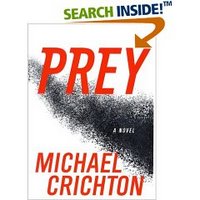
Prey


Prey
Michael Crichton
Harper Collins 2002
From the inside cover:

"In the Nevada desert, an experiment has gone horribly wrong. A cloud of nano-particles -- microrobots -- has escaped from the laboratory. This cloud is self-sustaining and self-reproducing. It is intelligent and learns from experience. For all practical purposes, it is alive. It has been programmed as a predator. It is evolving swiftly, becoming more deadly with each passing hour. Every attempt to destroy it has failed. And we are the prey.

Drawing on up-to-the-minute scientific fact, Prey takes us into the emerging realms of nanotechnology and artificial distributed intelligence -- in a story of breathtaking suspense."

As I said yesterday, I enjoyed this book. It was a fast read, heavy on concept and plot, light on characterization and setting. Not surprisingly there was quite a bit of exposition on artificial distributed intelligence/computer programming and evolution. What intrigued me, I guess, were the concepts of evolution as applied here. I don't believe there's much empirical or rational justification for the notion of species evolving into other species, and even when they use the term for viruses, "evolve" seems a misnomer. It's not like viruses are turning into cats or even into bacteria. They remain viruses and merely have different effects on the organisms they invade. However, reading this book it occurred to me that perhaps one place where evolution might truly apply is in the area of thought.

Now I'll freely admit that I don't know much at all about computer programs, and I hardly feel that reading this book has done much to change that. But it seemed to me that he was talking about something that was originally programmed to do a certain thing, including innovate in the attempt to achieve its goals, but because it was self-organizing and self-reproducing, at some point it went beyond the original program and began to program itself. With each successive generation the swarm upgraded its appearance and mode of operation to an increasing level of sophistication and complexity.

Computer programs are systems of commands, assumptions and instructions, some of which can, as a result of outside stimuli, "evolve." Or at least that was the impression Prey gave me. As such it struck me as an excellent metaphor for the system of false thinking with which Satan has deceived the world.

Likewise, the worldly thought system contains commands, assumptions and instructions. With each new truth that God reveals, it shifts and adapts, reorganizing itself to a greater level of complexity, subtlety and sophistication. You can see this over time in the history of ideas, particularly religious/theological concepts (among which I consider evolution itself). Science, as I mentioned in an earlier post, is constantly changing its view of what is true. Ditto Psychology. Education. Medicine. Today, philosophies and various religious viewpoints abound, the result of a constant shifting of perspectives and priorities, the acquisition of "new" information, and the changing view of what truth is and how it can be perceived.

All of which is quite interesting when you consider the Bible says there is an agent at work, a grand creature of great genius who is said to be the prince of the power of the air and the ruler of the world. One who has schemes and plans to continue in his deceptions, evolving them as old concepts prove false and new truths emerge for him to combat. In some cases he brings back old ideas in more complex forms -- gnosticism, for example. Environmentalism. The old phallic cult of ancient times (and if you don't think that isn't present, even rampant in our sex-crazed society of today...better think again. You don't have to have a temple or a grove to worship something.) And the evolution is the result of what he does relative to what God does.

When you step back and think about it, the magnitude of falsehood and deception is immense. Mind-boggling. And apart from knowing God's word, we have no hope at all of escaping deception. Even knowing it, we are at risk because some of Satan's greatest lies -- some of his best work -- relate to the Bible and Christians. Satan knows the word of God, after all. He tempted Jesus with it in the desert. He presents himself as an angel of light; his ministers come to us claiming to teach us how to be righteous. He has another Jesus, another Gospel, another communion table... And just like the swarm in Prey, his lies are constantly shifting form, adapting, attacking, imitating truth and seeking a way to live symbiotically with it. Which, of course, is ultimately impossible.

Grace,
Karen

Monday, August 21, 2006

August SF/F Blog Tour: Kathy Tyers


Today marks the first day of the August Science Fiction and Fantasy Blog Tour. This month the tour is highlighting the work of author Kathy Tyers, with an emphasis on her Firebird Trilogy. Published in 1999 by Bethany House, Firebird was the first in what has turned out to be a new wave of Christian SF. Beth Goddard is coordinating the tour from her blog, Writing with Fire.

Kathy is well known outside of Christian circles as the best-selling author of the Star Wars novels, Truce at Bakura and Balance Point. She also has the distinction of having published three of her novels with two different publishing houses. The original Firebird and its sequel, Fusion Fire, were first published by Bantam Books. Though Kathy had hoped Bantam would take the final in that series, Crown of Fire, the evil marketing gnomes (okay, maybe they weren't technically "evil"... ) intervened and she was instructed to write something entirely new. So she penned the delightful Crystal Witness, followed by the Nebula Award nominated Shivering World, Truce at Bakura, and finally her last book with Bantam, One Mind's Eye.

There followed a period of spiritual and artistic redirection, from which she emerged with the Bethany House contract to reintroduce Firebird and Fusion Fire, this time bringing into greater relief the already existing faith elements in those books. Even better, Bethany House wanted her to finish Crown of Fire, which had been so frustratingly left hanging. What a blessing to see that book finally in print! Not only for her but for the rest of us as well -- a real-life example of how the Lord can breathe new life into something we thought was entirely dead and without hope of resuscitation. Today, all three volumes remain in print as a three in one volume, The Firebird Trilogy.

In addition, Bethany has republished Shivering World, also with increased focus on and development of the faith elements. Kathy's also written a number of Star Wars short stories for inclusion in anthologies and a travel guide to the Rockies, where she's lived until recently. Her most recent book Grace Like a River, a biography of her friend, Classical guitarist Christopher Parkening, just released from Tyndale House this summer. For a complete listing of all her books, check her website, www.kathytyers.com .

Have fun, and if you've not yet tried any of Kathy's work, I recommend it highly.

Thursday, June 22, 2006

Blog Tour: Sharon Hinck

Sharon Hinck has been a friend and a faithful supporter of my work, and me, for several years now. She is an excellent writer herself, possessing a wonderful way with words, a great sense of humor and the ability to create living, breathing, very likable characters who immediately upon meeting them seem like old friends. I was introduced to her work through her fantasy novel, The Restorer, which tells the story of a soccer mom wrenched unexpectedly into an alternate world which she is called upon to deliver. It's a parallel to the story of Deborah, the first in a series of three, and I loved it -- even wrote an endorsement for it, something I rarely do.

We have been waiting now for the Lord to open the doors at just the right time and place for it -- and as it turns out, just yesterday she shared with me the news that those doors have opened. Nav Press has bought all three of the Restorer books, and plans to release them approximately 4 months apart starting June of 07. Hooray!

But that's not our subject today....

Because while Sharon waited for the doors to open for her fantasies, she took a divergent tack, focusing on the more marketable mom aspect of her writing interests to pen The Secret Life of Becky Miller. (No, it is not an expose of the Becky Miller who occasionally comments here and has her own blog, A Christian Worldview of Fiction! LOL)

The new book, which Bethany House is releasing this month, is classified as “mom-lit” though it does incorporate a few fantasy elements in the form of Becky's rich -- the back cover calls them "grandiose" -- adventure-filled daydreams. Sharon’s Becky is a young mother who yearns to do great things for God as she deals with toddlers, laundry, noodle boil-overs, and other domestic crises, only to realize that these days of small things and small choices can be just as important in God's sight as the big ones.

For more about the book visit The Secret Life of Becky Miller, and be sure to check out the different interviews of Sharon (some are very clever departures from the norm!), book reviews and book giveaways on her June blog tour which is kicking off the release of her debut novel.

The Secret Life of Becky Miller is already receiving rave reviews from readers:

"I started reading your book and couldn't put it down. You describe feelings I didn't know how to put into words."

"...the insight (Hinck) brings to Becky's spiritual journey brought tears to my eyes and left me gasping for air. Warning: Do not read this book late at night next to a sleeping husband. You won't be able to put it down and your laughter will awaken him."

"In the style of James Thurber's Walter Mitty, Sharon Hinck delivers an exceptional read that will touch your heart and your funny bone. By the end of the book, you'll feel like Becky Miller is your best friend." —Tim Bete

If you're a young mom who struggles to do it all perfectly, you'll certainly relate to Becky Miller, and even if you're not, the book's a fun, enlightening and well-crafted read.

Karen

P.S. Sharon is running a contest for a free book on her website. Her agent came up with some whacky title ideas for future Becky Miller books which she's posted on her “Just for Fun” page. After you read them, send her your own funny ideas. She’ll compile the best ones to post on her site AND draw from the entries. The winner will receive a free autographed copy of THE SECRET LIFE OF BECKY MILLER. http://www.sharonhinck.com/.