Showing posts with label book reviews. Show all posts

Sunday, June 21, 2009

Good and Evil

Here's the continuation I promised on Friday of the thoughts prompted by my reading of Dean Koontz's One Door Away From Heaven, which hinge on the nature of good and evil. This question, this examination, this setting together for contrast of good and evil is something Koontz does often.

Unfortunately, the more I've come to understand about God's word, the more I see Koontz doesn't know what he's talking about. Thus it's no surprise that he's a best-selling author with 40 some books to his credit and a vast following of fans. And if he doesn't understand the difference between good and evil, he's certainly not alone. It is not in Satan's interest for people to understand and he works hard through his army of fallen angel-minions to see that they don't. One of his methods is to make people think the whole dichotomy doesn't exist -- there really isn't "evil" per se. It's just a perception. There really aren't demons and a devil, that's comic book stuff. (It's interesting to note that he never really goes for the argument that there isn't good, though perhaps with the rise of postmodernism he's moving in that direction -- but that's another subject).

One of the things I don't think people realize about the Tree of the Knowledge of Good and Evil in the Garden of Eden was that the good was not divine good. This was not the difference between Satan's evil and God's goodness. Adam and the woman already knew about God's goodness. What they didn't know about was Satan's evil and his form of goodness.

Another thing I think many don't realize is that Satan and his followers really don't, as Koontz in his One Door Away from Heaven described, "seek only to serve entropy. They love chaos, destruction, death." Satan isn't trying to do away with God, he's trying to take God's place. He wants the power, he wants the worship, he wants to do good.
"I will ascend to heaven. I will raise my throne above the stars of God (other angels), I will sit on the mount of assembly in the recesses of the north. I will ascend above the heights of the clouds; I will make myself like the Most High." (Is 14:13,14)
The Most High is not into destruction and death and entropy. The most High is into creation and order and stability.

Theologian Lewis Sperry Chafer remarked in his Major Bible Themes,

"Satan is not aiming to promote sin in the world. He did not purpose to be a fiend, but rather to be "like the most High"; he is not aiming to destroy so much as he is to construct and to realize his own ambition for authority over this world-system with its culture, morality, and religion (2 Co 11:13-15). The impression that Satan is the direct cause of sin is not true because human sin is said to come directly from the fallen human heart (Gen 6:5; Mk 7:18-23; James 1:13-16)
It's this good on the part of people that Satan most wants to promote -- good performed by people, or human good. That's the knowledge that the woman gained: the idea of doing her own thing for good. Even Satan's invitation to her was to do a good thing: "Eat that fruit and it will make you wise. You will be as smart as God, and that would surely be a good thing. You could converse with Him better, know better what He wants from you, understand Him better. Be His friend better."

When she brought the fruit to the man, there's cause to think she might well have believed she was helping him out, for Paul tells Timothy she was "quite deceived." And if she'd realized she was naked, why didn't she hide from the man and cover herself with leaves before approaching him? Why did she bring him the fruit? Why only after he had eaten did they realize they were naked and go looking for leaves to cover themselves?

Human good, creature credit is what powers most religions. It's what powered the unbelieving Pharisees in Jesus' day and prevented them from seeing the truth of who He was. It is way worse than sin. Sin was dealt with on the cross. Human good blinds. Human good feels good to those who perform it. It feels right and keeps people from the truth, from freedom, from really knowing God.

Just like Cain bringing all that produce, the work of his hands, they think their good works will please God. Cain probably expected God to tell him he'd gone above and beyond, bringing an better offering than Abel's. He totally didn't get the point of the slain lamb as a picture of the offering God himself would eventually make to pay the penalty for man's sin. He didn't understand that he was depraved and that nothing he would ever do could come close to the perfect righteousness of God. He thought he could by his own actions please God.

Believers do this as well. Paul warns the Galatians about it: having come to Christ by faith, will you then be perfected by the flesh? Your own efforts? Your own good works? He warns the Corinthians of the ministers whom Satan sends out among the brethren to teach others how to be righteous. They look good. They look spiritual. They seem right. And they are not.

All of which is why the theme in Koontz's book so annoyed me. Here it is as he stated it:

"None of us can save himself; we are the instruments of one another's salvation, and only by the hope that we give to others do we lift ourselves out of the darkness into light."
He did mention God in the book. In fact, it was by the savior-angel character's bonding with a dog that the character could perceive God. If this character touched a dog while it was sleeping, he would experience the peace and joy of knowing God as the Playful Presence perceived by dogs all the time. Moreover he could teach people to do the same and by this "save the world," because in perceiving the Playful Presence they would experience joy and peace and would know they were unconditionally loved.

Jesus was mentioned in only one conversation and that mockingly. When one of the heroines is trying to get a PI to help her, she is quite pushy and he remarks at one point,
"You ought to sell Jesus door-to-door. The whole world would be saved by Tuesday."
Later in that same conversation, she says, again echoing the book's theme,
"Sometimes a person's life can change for the better in one moment of grace, like a miracle almost. Someone so special can come along, all unexpected, and pivot you in a new direction, change you forever. You ever had that experience, Mr. Farrel?"

He grimaced. "You ARE peddling Jesus door-to-door."
So weird, so close to truth. Yes, your life does change for the better in one moment of grace, and it is a miracle when you believe in Christ and are made new, given eternal life right then and there. He, Jesus Christ, is the one so special who comes along and can pivot you in a new direction, change you forever... It seems amazing the words uttered by this character can be so close to the truth and yet, be derailed by focusing on the wrong object.

But this is what Satan's cosmic system and deception is all about. A little bit of truth, maybe even a LOT of truth, and a little bit of lie, and it's all distorted.

So that's why this wonderfully written book annoyed me. Because the author used truth to cloak a dreadful lie, because he even used it to slight the Lord. Instead of seeking God through his Word, through believing in Christ we are advised to find a sleeping dog. This sounds absurd as I set it down, but because Koontz is so good at what he does, it is not nearly so laughable in the story. And truth distorted by one little lie, the whole cloaked in a wonderfully appealing cloak of "rightness", has always been Satan's best work for deceiving people.
"And the great dragon was thrown down, the serpent of old who is called the devil and Satan, who deceives the whole world..." ~ Rev 12:9

~~~


Friday, June 19, 2009

One Door Away From Heaven

I said Wednesday I would blog on my thoughts about One Door Away From Heaven by Dean Koontz, one of the two books he graciously autographed to me. Because he did autograph it, I felt that I should only have good things to say about it. And mostly I do. But there was an element -- the theme -- that greatly annoyed me. In fact I was all ready to write about that and then went to Amazon to check out what other reviewers had to say and...

That was most beneficial, both in instructing me not to take those reviews at all seriously (some people do not seem to actually know how to read, given the things they see or don't see in a book) and in getting me to take another look at my reaction, which overall was far more positive than that of the people grousing at Amazon. (The teacher of English was especially out to lunch, giving the book one star, railing at it for its horrible writing and its terrible use of metaphor. And even transcribing one of his horrible sentences, which was -- Heaven forbid! -- 84 words long! Horrors! How can this be?! She would have given his work an F were he in her class.)

What's funny about this is that he doesn't have a lot of respect for English teachers and their effects on those with a talent for creative writing, and he devotes a fair amount of discussion to this in his How to Write Best-selling Fiction. In his opinion they don't have the first idea what writing fiction is about and generally will squelch and derail any creative impulses on the part of their students should they happen to manifest.

It's also funny because I seem to recall from one of William Faulkner's novels a sentence that went on unobstructed for over a page, but none of my English teachers were calling him a horrible writer for doing this. So not only does Koontz not have the corner on long sentences, his being maligned for it is inconsistent with what English teachers accept from someone else, now dead and held as a Great Writer.

Finally, it's funny because in HTWBSF, Koontz also discusses his penchant for experimenting with form and technique to get the best effect for what he is trying to convey in a book. That's why he chose to use the present tense for one of his points of view in this story (which appalled the teacher) (though it's not the first book by any means where he's done it) and why he chose to create a sentence 84 words long. I believe he was in that sentence trying to convey a smoothness of chaotic motion. The words and their form mimic the image he is communicating and I think he did a good job.

So, having read some of the reviews, instead of complaining about the theme, I end up defending him! LOL.

Despite my complaint, I did not find this book boring at all, nor did I find the writing tiresome, or the metaphors overdone. I enjoyed most of them. For example (relating to a brewing storm):
As dark as iron in places, the sky at last grew heavy enough to press an anxious breath from the still afternoon. The pleasantly warm day began to cool. All around Micky, trees shivered and whispered to the wind.

Birds like black arrows, singly and in volleys, returned to their quivers in the pine branches, with flap and flutter, vanishing among the layered boughs: a reliable prediction that the storm would soon break.
Here's another one:

The first bolt of lightning, thrown open with a crash, had not unlocked the rain. The longer part of a minute passed before another bolt, brighter than the first, slammed out of the hasp of the heavens and opened a door in the storm.

Scattered drops of rain, as fat as grapes, snapped into the oiled lane that served the many campsites, striking with such force that sprays of smaller droplets bounced a foot high from each point of impact.
I also liked the characters, and unlike some (was it that teacher again?) did not find them unbelievable at all (especially since I am now reading Hollywood Interrupted, which examines the behind-the-scenes lives and culture of the elites of the entertainment industry; some of those people are VERY much like Koontz's villains here). I'm always amazed at how he creates likable, believable, flawed but very quirky -- and thus interesting -- characters. They can have somewhat lengthy conversations that remain amusing and interesting and just pull you easily through them.

His openings are always immediately gripping. Here's One Door's:


The world is full of broken people. Splints, casts, miracle drugs, and time can't mend fractured hearts, wounded minds, torn spirits.

Currently, sunshine was Micky Bellsong's medication of choice, and southern California in late August was an apothecary with a deep supply of this prescription.
Another metaphor there, which I also enjoyed. That first line is also part of the book's theme, which concerns what actually will heal those broken people. Of course, as a believer in Jesus Christ, I know the answer. I know the man, the One True Healer. It's only through believing in Him that anyone can be "healed."

This was not Koontz's answer however, which is hardly surprising. And because it is not, as you have probably guessed, that is partly what annoyed me. The other part of what annoyed me is that he presented his faulty solution so darned well. It seems so good, so nice, so "true" from the human perspective. The words, the story, the characters all work together to make you feel so good about it, when it is a lie. In fact, it is the worst kind of lie and the worst kind of evil. For how great is your darkness when you believe you are in the light?

I find it ironic that the Publisher's Weekly review of this book, which was on the whole favorable, concluded with this statement:
"For all that, the novel is surprisingly focused on its inspirational message "we are the instruments of one another's salvation and only by the hope that we give to others do we lift ourselves out of the darkness into light" and conveys it with such conviction that only the most critical will demur."
So that makes me one of the minority "most critical," but yes, I do indeed demur ("to object mildly to something") (what is it about PW that I keep having to look up the words they use in their reviews?) Except I don't object mildly. I strongly and strenuously object. In fact, it makes me want to gag. But I'll save that for my next post.


~~~


Wednesday, June 17, 2009

Me and Dean Koontz

As I mentioned in a post back in 2007, the only published author I ever wrote a fan letter to was Dean Koontz. I may have told bits and pieces of this story over time, but today I'll put it all together. I can't recall when I first read his book Watchers. It was probably a good twenty-five years ago. I loved it. I was amazed by it. I immediately began reading others of his books, including his Writer's Digest book, How to Write Best-Selling Fiction, now out of print. (Or maybe I read that first, seeing as my Berkeley edition of Watchers is dated 1988, whereas my Writer's Digest edition of HTW Best-selling Fiction is 1981) Anyway, my copy of the latter is highlighted and worn. It became my central text on learning to write, and his books my illustrations.

Later, I used several of his openings as comparisons with my own (an unpublished opening for The Light of Eidon), in a process I describe in an article on my website entitled "Mentoring without Meeting." I pulled out the first paragraphs and set them side by side, examining and comparing each sentence to see what his did in comparison to mine did. I learned a lot from that and I've now
read at least 32 of his books.

Thus, when The Light of Eidon came out, I marshaled my courage and sent him a copy of it along with a letter explaining my indebtedness to him and my appreciation for his work. I figured he surely didn't have time to look at reader mail, let alone read the published book of some fan, but you never know and possibly one of those staff members might read Eidon, even if Koontz did not. I have no idea if he read it -- mostly likely not -- but a month or so later I received a box from him, containing two hardcover books autographed to me (see the pic above for one example) from him and Trixie, his dog, since I'd mentioned myself as a longtime dog lover.

There was also a wonderful personal letter from Mr. Koontz, along with the form letter that usually goes out and a copy of his newsletter, Useless News which was quite funny as well as being enlightening and encouraging. (I'm still on the mailing list, just as the newsletter warned: "...you're on our mailing list , and there's nowhere to hide." So I'm doomed forever to receive Useless News! Fortunately I enjoy them immensely.) I was overwhelmed with his graciousness and his generosity.

The first of the books that he sent me was From the Corner of His Eye (2000), which I finally got around to reading in June of 2007 and blogged about in the same post I mentioned above.

The second was One Door Away From Heaven (2001), which I finally read last week and will blog about tomorrow. As I mentioned the other day, my thoughts about it, on balance were not positive, but that's not because of anything regarding the writing, the characters, the plot (I read it in less than a week, after all, and it's a 607 page book) but rather because my theological/doctrinal viewpoint clashed strongly with the viewpoint he was putting forth in the book. A clash that many in the world would probably find surprising...

But more on that tomorrow...

~~~

Monday, May 25, 2009

The Hunt for Bin Laden

Over the weekend, I finally finished Robin Moore's The Hunt for Bin Laden -- Task Force Dagger (2003), which I bought in hard cover not long after it came out because it not only looked interesting (I'd read a review) but because I thought it might be a fun source of light research for The Enclave. Moore, "the first and only civilian ever allowed to go through the grueling Special Forces qualification course at Fort Bragg" is the author of The Green Berets.

The book covers the first engagement in American's War on Terror: the special forces twelve-man teams that infiltrated into different strategic areas of Afghanistan shortly after Sept 11, 2001 and aided the Northern Alliance in its battle against the Taliban. Sixty-two days later, with the liberation of Kabul, the campaign was over and won. A group of only a few hundred men had decisively defeated an enemy force of one hundred thousand. The book takes you right into the heat of battle, from the eyes of the Green Berets who fought it, and shares the successes and the foibles of their effort.

Unfortunately, it was only as I was looking up the Amazon url for this review that I discovered some of it was made up. Not by Robin Moore, but by one of his sources, Jack Idema (refered to in the book sometimes as the mysterious Jack and others as Keith Idema) who apparently did extensive editing on the ms Moore and his co-writer produced. This Jack claimed to be a Green Beret, and while he was apparently accepted into the program, he ended up being kicked out. There are all sorts of one-star reviews at Amazon, decrying the book, including one which claimed Moore has since disavowed the book. Not wanting to rely solely on Amazon reviewers, I investigated further...

Wikipedia confirms the controversy and also that Moore has disavowed the book. Citing Robert Young Pelton's book, Licensed to Kill: Hired Guns in the War on Terror, the article states, "Though [the Special Forces soldiers] never met or talked to Idema, and despite the fact that almost ten members had carefully detailed their actions to Moore at K2, the first chapter puts forth an account of the team's infill into Afghanistan that the men tell me has been entirely fabricated."

Nor was it just Moore he snookered. Apparently he spent a good deal of time conning a lot of people in the press as the Wikipedia article documents, including Dan Rather (that probably wasn't all that hard). Idema was convicted in 2004 of running a private Afghan prison and torturing Afghani's, but even before that he had a long history of crime.

That'll teach me to buy a book and take years to get around to reading it. Now I'm wondering if any of it is valid.

Probably some of it is, at least on the general level. One of the things that I was most struck by was how the SF guys would get into position on the ground and then call in the air support -- bombers, fighters, gunships, etc -- is probably ... Since I have a few friends who work on various weapons systems (as does my hubby) it was cool to see how it all works in action.

However, this revelation does explain the sometimes almost incoherent writing, and the weird episodes with "Jack". Though I'm told that Jack rewrote the manuscript in order to give himself a greater role, he failed in that attempt. The parts that centered on him seemed out of left field, having nothing to do with the rest of what was going on. He's the incredible young recruit who loved Moore's ballad The Green Beret and read the book which led him into becoming a Green Beret himself. Later, as "Keith Idema," he appears as the "retired" Green Beret savior of the National Geographic documentary maker Gary Scurka (with whom he'd actually entered the country); still later, he's the legendary superspy/soldier/advisor to the NA in Afghanistan... "Are there many men who call themselves Jack?" Moore supposedly muses, "Or is there only one incredible guy?" There's even an Epilog, all about Jack, which is really out of left field. I read it wondering, "Who is this guy? Why are you telling me about him sitting around in this bar lamenting the loss of the war and ruminating on how great he is? I don't recall him doing anything to speak off in the rest of the narrative..."

So, it's too bad. Lies infiltrate truth and the whole is tainted. After the controversy, publisher Random House quietly let it go out of print and the whole book died into obscurity. But it's also an excellent illustration of how the cosmic system works. Satan loves to take the truths of God and infiltrate them with lies. Just a few and then you don't know what is true and what is not, or you've gotten pointed off in the wrong direction, operating on assumptions that are false, while they seem true...

There are some other books to read about the war, and I may, but right now I still have some books on my shelf. But maybe I'd better check their Amazon entries before I start reading...

Wednesday, April 22, 2009

Fossil Hunter

It's been a year since I've read a book. Actually more than a year if you're talking about a book I've actually been able to finish. Last June, I started reading Fossil Hunter by John B. Olson, a book which was released a year ago April. Before I could finish it, though, I got the editor's response on The Enclave and had to stop reading to focus on the rewrite... which, as anyone who reads this blog knows, took me a LOT longer than I'd anticipated.

But, having finished that last week, one of the first things I did was pick up Fossil Hunter again. It had been so long, I had to start over, which was fine since I'd pretty much forgotten what I'd read previously. This time I was able to sit down and much read it more or less straight through. What a pleasure to be able to do that! What a difference it makes in the coherence of a story!

From the back cover :

In the desolate Iraqi desert, a lone shepherd stumbles across a whale fossil. Initial analysis indicates that it could be a new species -- a discovery that might shed light on the evolution debate.

Paleontologist Dr. Katie James is asked to lead an expedition to recover the rest of the fossil before her archrival, Nick Murad, can find it first.

But while she's there, Katie also uncovers the unexpected -- a human fossil so controversial she's forced to collaborate with Nick to analyze the find before it can be destroyed by a fundamentalist faction of the Iraqi government. Their initial results fly in the face of current scientific theory, and it seems the whole world turns against them,including those they thought they could trust.

Then the fossil disappears, sending Nick and Katie on a chase that could cost them their reputations, their careers -- even their lives.

I enjoyed it! It was an easy read, and I think I like stories about groveling around in the desert. Dirt, heat, thirst... fossils... And of course the debate regarding evolution versus intelligent design versus creationism has long been a subject of high interest for me.

And while I don't agree with the evolutionary stance of his protagonist ("directed evolution" is the term, I think) the various discussions he presented were quite thought provoking. So much so that I've decided to do a few posts out of the wealth of thoughts I wrote down. (Okay, and because The Enclave also deals with this debate, albeit peripherally.) Tomorrow I'll post about my background with regard to evolution, and next week I'll set down some of the observations, agreements and objections I had while reading. At least... that's the plan...

~~

Monday, November 26, 2007

Next

Recently I finished reading Michael Crichton's Next, another book on my list of novels for research. Like his previous book, State of Fear, this one takes on an emerging and increasingly political scientific problem, that of genetic engineering. Like State of Fear, this one has a significant bibliography of intriguing books in the back, as well as the author's conclusions as to what should be done about some of the problems raised in the book.

The first is that we stop patenting genes, which seems to me to have been a harebrained notion from the start. As Crichton points out, a gene is a fact of nature, not something someone invented. It's like patenting a disease or turtles. Or, noses, the examples he gives. If noses were to be patented then everything to do with noses would require a license from the patent holder -- glasses, cosmetics, breathe-right strips, medications, etc.

I didn't like this one quite as well as State of Fear, because it was much more focused on its technical subject and the potential consequences than the characters. And while I found the subject fascinating, there were a lot of characters -- at least fourteen viewpoint characters that I can recall off the top of my head. And in the end I rooted most for the transgenic chimpanzee and parrot. I especially enjoyed the parrot, Gerard, who could do math. He was very cool.

I made notes as I read, some directly applicable to Black Box, some just for personal interest. Like,

"Persistent hype lends unwarranted credulity to the wildest claims. For example, stem cell research is being touted as the coming miracle. Because of all the hype, people believe miraculous cures are just around the corner... and so do scientist." (Who are people, too, after all, and just as subject to hype as the next person; maybe even more subject to it if it happens to coincide with their own hopes and dreams of finding those cures)

"Scientific institutions love hype -- it brings grants. Yale, Stanford and Johns-Hopkins promote hype as much as Exxon or Ford. So do individual researchers at those institutions."

"Science is as corruptible a human activity as any other. Its practitioners aren't saints; they're human beings and they do what human beings do -- lie, cheat, steal from one another, sue, hide data, fake data, overstate their own importance and denigrate opposing views unfairly."

This latter makes me think of American Gangster, which ended with a note at the end to say that when Richie Roberts finally brought Frank Lucas to justice, Lucas agreed to help him root out the corruption in the New York Police force at the time -- in exchange for a lighter sentence, naturally. It turned out that they indicted something like two-thirds of the drug enforcement section of the police department. Of all people, you expect police -- and military personnel -- to be upright and have integrity. And I suppose you would expect it from doctors and pastors. And since scientists are allegedly on a quest to discover the truth about how things work, you would think they would be especially scrupulous about objectivity and honesty. But that's only if you forget that they, like all the rest of us, have sin natures and are vulnerable to greed, pressure, intimidation, and the prospect of becoming fabulously successful. Also arrogance, stubbornness, bias, subjectivity, blindness and delusion.

It was interesting to see Crichton mention this. Especially in light of the book I'm reading now, Intuition, also about science, and taking all this to a new and intriguing level. But more on that later.

Grace,
Karen

Wednesday, October 24, 2007

State of Fear - 2

Okay, I thought I was done with State of Fear, but there is one more element that I really enjoyed: seeing the various techniques of argument set against each other in a situation where I wasn't personally emotionally involved. I've been reading off and on recently about techniques of debate, recognizing some of them as things I've encountered without even realizing what they were (like the "say it enough times with great authority and you'll be believed" technique) and this book had some more examples.

What I'm seeing is that just because the listener reacts and won't listen or completely dismisses what the speaker says, doesn't make the speaker wrong or remiss.

In one sequence Evans, the main pov character and global warming advocate, has just been shown a page of fully documented references to scientific studies -- hard data showing that Antarctica, after 6000 years of warming is now actually cooling. Only a small localized portion of it is warming. Overall, it's the other way around. Evans ignores the information Kenner has given him, so Kenner says,

"You thought the Antarctic melting was something new?"

"I thought it was melting faster than previously," Evans said.

"Maybe we won't bother any more," Kenner said.

(His assistant) nodded and started to put the computer away.

"No, no," Evans said. "I'm interested in what you have to say. I'm not close-minded. I'm ready to hear new information."

"You just did," Kenner said.

So he looks over the references they gave him a little more closely and...

... folded the sheet carefully. "These studies are probably financed by the coal industry."

"Probably,"Kenner said. "I'm sure that explains it. But then everybody's paid by somebody. Who pays your salary?"

Kenner goes on from there to lead Evans into admitting that he works for an environmentalist firm, and inquires if it would be fair to say that his opinions are what they are because of it. Evans hotly denies this, but Kenner pushes him a bit more until he's really irritated. At which point Kenner says,

"Now you know how legitimate scientists feel when their integrity is impugned by slimy characterizations such as the one you just made. We gave you a careful, peer-reviewed interpretation of the data... Your response was first to ignore it, and then to make an ad hominen attack. You didn't answer the data. You didn't provide counter evidence. You just smeared by innuendo."

Evans's response to this to to swear at him, insult him further and conclude that "Nobody agrees with you." Another non-argument. When Kenner points out that the scientists who wrote the papers cited on his list of references do agree with him, Evans throws up his hands and with one final expletive, walks away.

Fascinating. I have been on the receiving end of this. I will express an opinion, and people will ignore it, belittle it, then make ad hominen attacks. Press them and they get madder, say "to heck with you," and walk away. The really bad thing is that I know that on occasion I have done the same thing when someone else says something I don't agree with.

It's because we get emotional. And when that happens we stop thinking. It seems enough to just say "That's ridiculous! Nobody agrees with you! Everyone knows the Bible is true!" (or whatever). But it's not. You have to keep thinking and leave the emotion out of it. Emotion has no thoughts, no standards. It just sputters and shrieks. Instead of thinking about the issue, it attacks the person who is not agreeing.

Which, strangely enough, is exactly the subject we started studying in Bible class tonight. The doctrine of emotion... Though when I sat down to write this blog, I had no idea I was going to make this connection... :-) Really!

Grace,
Karen

Tuesday, October 23, 2007

State of Fear

During my convalescence from the broken arm, one of the books I read (way back in August, now) was State of Fear by Michael Crichton. It was a quick, effortless read, and I really enjoyed it. Crichton has a lot of swift dialogue exchanges so the book isn't as long as the pages make it look.

Making his main viewpoint character a global warming believer was the perfect way to handle the material he wanted to deal with. The hero, John Kenner (a professor of environmental science who was not the viewpoint character), really knew his stuff and when he encountered a global warming fanatic, he'd ask them questions. Like could they back up their beliefs with facts? Usually they couldn't. It was just, "everyone knows this is true!" but no specific data. No familiarity with the texts, the actual studies, or with the fact that many of the conclusions about global warming have been drawn from computer models - which are only guesses - and not hard data.

Here's an amusing sequence:

"So," Kenner said, "Global warming represents a threat to the world."

"Absolutely," Bradley said. "A threat to the whole world."

"What sort of threat are we talking about?"

"Crop failures, spreading deserts, new diseases, species extinctions, all the glaciers melting, sea levels rising, extreme weather, tornadoes, hurricanes, El Nino events - "

"That sounds extremely serious," Kenner said.

"It is," Bradley said. "It really is."

"Are you sure of your facts? You can back up your claims with references to the scientific literature?"

"Well, I can't personally, but scientists can."

"Actually, scientific studies do not support your claim. For example, crop failure -if anything increased CO2 stimulates plant growth."

I love how Creighton pulls you through such exchanges with action. The exchanges themselves are always brief and somewhat contentious, salted in between the action sequences. The story is based on understanding all this, but it's slid in well.

This exchange and others like it made me think of the Bible and being ready to make a defense and maybe even being able to go on offense with Bible information. Kenner was completely relaxed and utterly confident of his facts. He knew what the studies were, had the references, and also realized what the media/world system was doing in terms of deception. How by simply claiming a thing was true enough times, they could bring people to believe it, whether it was true or not.

He didn't argue or get angry, he'd just question people. Eventually he'd cite the facts, complete with references to actual studies. When they responded with ridiculous claims in the face of that evidence, he simply stopped talking about it. In fact, more often than not he just said a little bit and moved on to another more immediate or practical concern. Or left entirely.

Crichton was also good at portraying people who knew nothing, but were very emotional and didn't want to consider facts or change their minds. They knew because it was "obvious" or because "everyone" knew that. I know people like that. I've had conversations with them. I always thought the problem was something in me, but now I'm seeing through this book that it might not be.

I'm also seeing the importance of being prepared with your references -- in my case historical, archaeological or scholarly facts, verses, etc). It's inspired me to move in the direction of preparing a defense... first of the Bible's credibility. Second of the claims of Christ. Not that someone who rejects the Bible as a legitimate authority can't still be swayed by its words. The Word of God is alive and powerful. Alive. It does things to people like no other written material or words can. But logically, defending the Bible -- which in the past is where I've fallen down -- is the best place for me to start.

Back to State of Fear... As I said I really enjoyed the character interactions, the action and the information. Crichton includes a substantial bibliography at the end, listing books he used to prepare for writing his novel. I only went through half of it and came up with a list of books I'd like to read that is probably twice as long as what I would ever be able to. But that aside, the book really moves and has a lot of intriguing, "different" elements. For all he wants to inform about global warming as a scam, Crichton never forgets that he's writing a thriller, either.

Grace,
Karen

Sunday, October 14, 2007

Why I Didn't Like This Book

One of the things I've noticed -- and perhaps struggled with the most -- in my experiences with today's Christian writing communities, is the strong thrust toward supporting one another and one another's works, regardless of the differences in doctrinal beliefs that might exist and the degree to which those differences are manifested in our stories. For some a difference in doctrinal belief is apparently of minor importance, rather like the difference between liking vanilla or chocolate. I've even heard some say that they don't care about theology at all, they just want to love Jesus. And the brethren. For one with that viewpoint, I can see where it would be easy to read and recommend books, movies, etc, regardless of doctrinal content.

I don't think that way, though. Doctrinal differences matter to me. Oh, I'll be the first to say that people have every right to believe what they wish to believe, and even to write stories that reflect those beliefs (indeed, if you're going to write, you should absolutely be writing about what you believe and care about!) What I have trouble with is recommending those books to others when they put forth things I consider to be against the Truth. If my heart cannot rejoice in something my mind rejects as false and wrong, how can I tell others to read it?

A case in point is a book I read recently, which I shall not name because I did not finish it and would not be able to recommend it, for reasons which I shall set forth below. In general I don't like to talk about books I haven't liked, but I thought perhaps this dissertation will shed some light on my approach.

My problems began with the book's premise -- that a man had been cloned from Christ's body using a cell found on the Shroud of Turin. My first thought was that God would never allow that to happen because it would have no meaning in His plan and would, in fact, seriously obfuscate important elements of the work and person of Jesus Christ. The whole reason for the virgin birth was so that Christ would have a human body without a sin nature. Which means his human spirit, imputed by God along with a human soul at birth, would not die on contact with a body contaminated by the sin nature passed down from a human father. He had to be spiritually alive, perfect -- sin free -- and yet, like Adam, have the will that would enable Him to sin if He chose.

If someone were to clone a body from a cell of Christ's humanity, God would still have to impute human life at the point of birth and why would He? There would be no point. God's entire intent was that we come into this world sinners, condemned from birth and in need of a savior. Breathing life into the perfect body of this clone would only be recreating Adam, and we've already been there, done that... Why would I want to read about something that would be completely pointless?

But the book is notable for its success in the field of Christian SF , so I finally decided to give it a try anyway. If story, writing and/or characters are strong enough I might overlook my doctrinal quibbles. Besides, the novel begins with an "Important Note from the Author" that says things in the book are not as they seem and we should keep reading. Okay, I thought. I'll read. The whole cloning thing could turn out to be a hoax...

Given that the main viewpoint character is an unbeliever, and that the character behind the aforementioned cloning project is also an unbeliever -- and one hostile to God -- this viewpoint seemed viable. I had serious trouble, though, when not too far into the book it was declared that the cells which were cloned had come from Christ's resurrected body. There was no way I could believe that, since resurrected bodies are not at all like regular human bodies (able to walk through walls, appear and disappear, fly, travel through space, etc,). The clone, however, did not seem to possess any of these powers, though as the book progressed, he did have some supernatural abilities...

Still working hard to suspend my very intense disbelief and lack of desire to even investigate these concepts, I persevered, holding on to that admonition at the start that things are not what they seem...

Only to run into the author's portrayal of an event which, though never referred to as such in the story itself, was obviously the Rapture. However, instead of vanishing as the Left Behind series presented it (and as I believe the Bible teaches), all the Christians dropped dead all over the world, leaving their bloated, decomposing corpses for those left behind to deal with. That's not only gross and macabre, but I don't believe God would do that with His royal family! The resurrection is a blessed hope, something we are to look forward to with eagerness and delight. Furthermore, we are to lights and blessing to the world, in life and in particularly, I think, in the finale of the Church age. To portray that moment as all of us dying physically in unison, leaving piles of dangerous, pathogenic "trash" behind, doesn't mesh with who we are in Christ nor, even more, with who God is. I thought the whole idea to be an insult to His character.

It also doesn't mesh with what Scripture has to say about the resurrection -- that it is not a physical death, but a bodily resurrection. The mortal shall take on immortality, and our bodies shall be changed in the twinkling of an eye, not left behind rotting. Jesus, the first fruits of the resurrection and the prototype for the rest of us, did not leave behind a body to rot, but was transformed, and we will be like him, caught up to meet Him in the air...

At this point I put the book down and did not read it for days. Then, since I was about halfway through, I decided yet again to set aside my objections and go on. It became clear that the clone was, indeed, not a good guy (I'm guessing the Antichrist) but now the story began to drag. There was too much political maneuvering, obvious, New Agey, demon-influenced characters, and an ever increasing list of elements that provoked my 'That's not the way it is/will be!" reflex. Also the story seemed to have become less and less about the characters, and more and more about presenting the author's view of end time events. The gradual revelation that his timeline for those events and the events themselves were not at all according to what I believe the Bible teaches was the straw that broke the camel's back.

There are many things out there to read, and not enough time to read even a small portion of them. At some point you have to make a decision as to whether you will devote any more time to a book you are deriving more moments of annoyance and disagreement from than pleasure. Thus about three quarters of the way through, I gave it up.

People who know me well would not find any of this analysis surprising. I do it with movies, too, though usually they don't have outright Christian principles they are portraying. It's in large degree why I am so picky about what I like. Sometimes that pickiness dismays me. On the other hand, I am what I am by the grace of God, and the same aspect of me that is so picky, is part of what I do when I write my own books. So I guess I'll just have to live with it.

Karen

Wednesday, July 11, 2007

From the Corner of His Eye

Yesterday I wrote about why I dealt with Gillard the way that I did in Return of the Guardian King, how I ...

*** more spoilers ***

***

***

***

... more or less phased him out of the narrative, both in terms of words addressed to him and in terms of his importance to the plot. When I was done, and encountered the objections of some readers who wanted to see more of him, I was reminded of a similar phenomenon in one of Dean Koontz's books.

A few years ago I read Koontz's From the Corner of His Eye, one of the two autographed hardbound books he sent me in response to a letter I'd written to him (the only letter I've ever written to an author!). I enjoyed it, of course, because I enjoy all of his books. I like his characters, I love his use of language, and I'm intrigued by some of the things that he does as a writer -- the names he gives his characters, the different allegorical elements in his stories, the plots, etc. In this book one of the themes was that evil is really empty and ultimately ineffectual. I'm not sure he intended this, but it's a beautiful truth relative to Satan and the Kingdom of Darkness. Satan's a lion and a hunter, but in the end, he has no teeth. Jesus has already defeated him. We just have to believe that and act accordingly.

Which, since we are fallen people living in the midst of a world of deception, isn't always so easy.

Anyway, in From the Corner of His Eye, Koontz introduces a perfectly awful villain in Enoch "Junior" Cain (and the name, of course, is no accident). [As an example of interesting things Koontz does with names, the hero, Bartholomew, starts out as a baby born to Agnes and Joseph, whose uncles are Jacob and Edom (where Esau lived) Isaacson... The co-hero, an ex-priest turned cop is Thomas Vanadium, vanadium being one of the elements on the periodic table, often used as a catalyst or in alloys. The "Thomas" harkens back to Doubting Thomas, as does the character.]

Anyway, back to Junior Cain. In the first few pages Koontz takes you from the beauty and wonder of a hike in the lush Oregon woods ("The primeval forests of the Oregon coast raised a great green cathedral across the hills, and the land was as hushed as any place of worship...") to the complete arrogance and self-delusion of this psychopath. He kills his wife, whom he tells himself he loves deeply and thoroughly, by shoving her off a lookout tower, for reasons I can no longer recall -- money, I believe. He derives a great feeling of power and life from doing it. And also remorse...

The self-delusion is fascinating and the journey is one where gradually you -- and Junior -- realize that he's hollow. He has nothing inside himself, no real capacity to enjoy anything, even though he has everything -- money, good looks, charming personality, the ability to commit a heinous crime and get away with it (which gives him great pleasure for a time). Eventually, as he sinks deeper into delusion and depravity, imagining himself to be greater than any other man, his disgusting insides begin to manifest on the outside. At the end, he is no longer handsome, but bald, pocked and burned, his life unraveling around him as his deeds come back to bite him.

And in the end, when you are expecting a big confrontation between him and Thomas...


**Spoilers here, too ***


*** Also some bad words***


*** Beware!***


...when you are expecting a big confrontation between him and Thomas, you don't get it. Cain is dispatched in a suprising and almost casual way that is completely anticlimactic. At first I was mildly put off, even a bit puzzled and disappointed. But then I thought about it and realized it was exactly right. Remember the point that Koontz kept making through the narrative? One of the walk-on characters encapsulates it well midway through the book:

"The problem with movies and books is they make evil look glamorous, exciting, when it's no such thing. It's boring and it's depressing and it's stupid. Criminals are after cheap thrills and easy money, and when they get them, all they want is more of the same, over and over. They're shallow, empty, boring people who couldn't give you five minutes of interesting conversation if you had the piss-poor luck to be at a party full of them. Maybe some can be monkey-clever some of the time, but they aren't hardly ever smart. God must surely want us to laugh at these fools, because if we don't laugh at 'em, then one way or another, we give 'em respect. If you don't mock a bastard like Cain, if you fear him too much or even if you just look at him in an all-solemn sort of way, then you're paying him more respect than I ever intend to."

I kinda think that's a good way to regard Satan, too.

Anyway, I saw it as perfectly right to have Cain eliminated by the weakest characters (physically, anyway) in the book, in an almost comical way to boot. If you go to the Amazon reviews, though, many readers were extremely distressed by the ending. Those who were didn't seem to understand at all what Koontz was doing. They were looking for something that wasn't there. They wanted Watchers or Intensity, and it wasn't that.

All of which I find interesting. Our frame of reference as well as our willingness to see what is actually being presented (rather than what we want to be presented) affects how we perceive things. If you don't see all the things he's putting in, don't make the connections between what's happening to Junior and statements like the above, then when you get to the end, you won't get what you're expecting and disappointment is in store.

Hmmm. I think this concept relates to our relationship with God, too. If we don't really know what His plan is about, then when we get to the end, we're going to expect something that isn't part of it, something entirely different than what He has in store.

Tomorrow, the last two questions...

Grace,
Karen

Wednesday, September 06, 2006

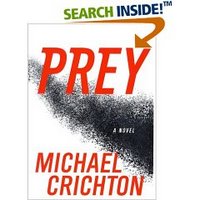
Prey


Prey
Michael Crichton
Harper Collins 2002
From the inside cover:

"In the Nevada desert, an experiment has gone horribly wrong. A cloud of nano-particles -- microrobots -- has escaped from the laboratory. This cloud is self-sustaining and self-reproducing. It is intelligent and learns from experience. For all practical purposes, it is alive. It has been programmed as a predator. It is evolving swiftly, becoming more deadly with each passing hour. Every attempt to destroy it has failed. And we are the prey.

Drawing on up-to-the-minute scientific fact, Prey takes us into the emerging realms of nanotechnology and artificial distributed intelligence -- in a story of breathtaking suspense."

As I said yesterday, I enjoyed this book. It was a fast read, heavy on concept and plot, light on characterization and setting. Not surprisingly there was quite a bit of exposition on artificial distributed intelligence/computer programming and evolution. What intrigued me, I guess, were the concepts of evolution as applied here. I don't believe there's much empirical or rational justification for the notion of species evolving into other species, and even when they use the term for viruses, "evolve" seems a misnomer. It's not like viruses are turning into cats or even into bacteria. They remain viruses and merely have different effects on the organisms they invade. However, reading this book it occurred to me that perhaps one place where evolution might truly apply is in the area of thought.

Now I'll freely admit that I don't know much at all about computer programs, and I hardly feel that reading this book has done much to change that. But it seemed to me that he was talking about something that was originally programmed to do a certain thing, including innovate in the attempt to achieve its goals, but because it was self-organizing and self-reproducing, at some point it went beyond the original program and began to program itself. With each successive generation the swarm upgraded its appearance and mode of operation to an increasing level of sophistication and complexity.

Computer programs are systems of commands, assumptions and instructions, some of which can, as a result of outside stimuli, "evolve." Or at least that was the impression Prey gave me. As such it struck me as an excellent metaphor for the system of false thinking with which Satan has deceived the world.

Likewise, the worldly thought system contains commands, assumptions and instructions. With each new truth that God reveals, it shifts and adapts, reorganizing itself to a greater level of complexity, subtlety and sophistication. You can see this over time in the history of ideas, particularly religious/theological concepts (among which I consider evolution itself). Science, as I mentioned in an earlier post, is constantly changing its view of what is true. Ditto Psychology. Education. Medicine. Today, philosophies and various religious viewpoints abound, the result of a constant shifting of perspectives and priorities, the acquisition of "new" information, and the changing view of what truth is and how it can be perceived.

All of which is quite interesting when you consider the Bible says there is an agent at work, a grand creature of great genius who is said to be the prince of the power of the air and the ruler of the world. One who has schemes and plans to continue in his deceptions, evolving them as old concepts prove false and new truths emerge for him to combat. In some cases he brings back old ideas in more complex forms -- gnosticism, for example. Environmentalism. The old phallic cult of ancient times (and if you don't think that isn't present, even rampant in our sex-crazed society of today...better think again. You don't have to have a temple or a grove to worship something.) And the evolution is the result of what he does relative to what God does.

When you step back and think about it, the magnitude of falsehood and deception is immense. Mind-boggling. And apart from knowing God's word, we have no hope at all of escaping deception. Even knowing it, we are at risk because some of Satan's greatest lies -- some of his best work -- relate to the Bible and Christians. Satan knows the word of God, after all. He tempted Jesus with it in the desert. He presents himself as an angel of light; his ministers come to us claiming to teach us how to be righteous. He has another Jesus, another Gospel, another communion table... And just like the swarm in Prey, his lies are constantly shifting form, adapting, attacking, imitating truth and seeking a way to live symbiotically with it. Which, of course, is ultimately impossible.

Grace,
Karen

Thursday, June 22, 2006

Blog Tour: Sharon Hinck

Sharon Hinck has been a friend and a faithful supporter of my work, and me, for several years now. She is an excellent writer herself, possessing a wonderful way with words, a great sense of humor and the ability to create living, breathing, very likable characters who immediately upon meeting them seem like old friends. I was introduced to her work through her fantasy novel, The Restorer, which tells the story of a soccer mom wrenched unexpectedly into an alternate world which she is called upon to deliver. It's a parallel to the story of Deborah, the first in a series of three, and I loved it -- even wrote an endorsement for it, something I rarely do.

We have been waiting now for the Lord to open the doors at just the right time and place for it -- and as it turns out, just yesterday she shared with me the news that those doors have opened. Nav Press has bought all three of the Restorer books, and plans to release them approximately 4 months apart starting June of 07. Hooray!

But that's not our subject today....

Because while Sharon waited for the doors to open for her fantasies, she took a divergent tack, focusing on the more marketable mom aspect of her writing interests to pen The Secret Life of Becky Miller. (No, it is not an expose of the Becky Miller who occasionally comments here and has her own blog, A Christian Worldview of Fiction! LOL)

The new book, which Bethany House is releasing this month, is classified as “mom-lit” though it does incorporate a few fantasy elements in the form of Becky's rich -- the back cover calls them "grandiose" -- adventure-filled daydreams. Sharon’s Becky is a young mother who yearns to do great things for God as she deals with toddlers, laundry, noodle boil-overs, and other domestic crises, only to realize that these days of small things and small choices can be just as important in God's sight as the big ones.

For more about the book visit The Secret Life of Becky Miller, and be sure to check out the different interviews of Sharon (some are very clever departures from the norm!), book reviews and book giveaways on her June blog tour which is kicking off the release of her debut novel.

The Secret Life of Becky Miller is already receiving rave reviews from readers:

"I started reading your book and couldn't put it down. You describe feelings I didn't know how to put into words."

"...the insight (Hinck) brings to Becky's spiritual journey brought tears to my eyes and left me gasping for air. Warning: Do not read this book late at night next to a sleeping husband. You won't be able to put it down and your laughter will awaken him."

"In the style of James Thurber's Walter Mitty, Sharon Hinck delivers an exceptional read that will touch your heart and your funny bone. By the end of the book, you'll feel like Becky Miller is your best friend." —Tim Bete

If you're a young mom who struggles to do it all perfectly, you'll certainly relate to Becky Miller, and even if you're not, the book's a fun, enlightening and well-crafted read.

Karen

P.S. Sharon is running a contest for a free book on her website. Her agent came up with some whacky title ideas for future Becky Miller books which she's posted on her “Just for Fun” page. After you read them, send her your own funny ideas. She’ll compile the best ones to post on her site AND draw from the entries. The winner will receive a free autographed copy of THE SECRET LIFE OF BECKY MILLER. http://www.sharonhinck.com/.